
Introduction
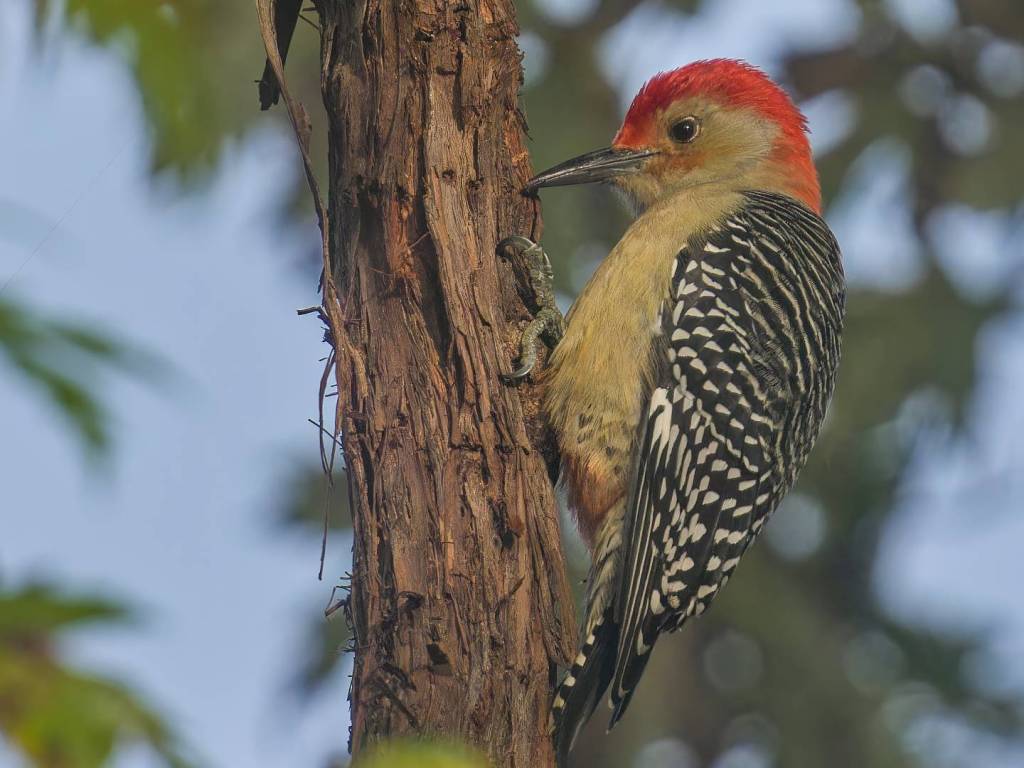
If you’ve ever heard a sharp, rolling call echo through the trees or spotted a black-and-white bird with a prominent red head clinging to the side of a tree, you might have come across the Red-bellied Woodpecker. Despite its name, the red on its belly is often hard to see unless you get a close look. What usually stands out more is the bold red cap that can make folks mistake it for other species. These birds are common in many wooded areas and suburban neighborhoods throughout the eastern United States. They’re curious, resourceful, and surprisingly loud for their size. In this post, we’ll look at how to tell the males and females apart, what makes them unique, where they live, what they eat, some interesting facts, and a look at the symbolic meaning some individuals associate with them today.
How Can You Tell the Difference Between Male and Female Red-bellied Woodpeckers?


Red-bellied Woodpeckers are sexually dimorphic, meaning you can tell males and females apart by appearance, if you know what to look for. The amount of red on the head is the clearest difference. Males have a red stripe that extends from their bill, over the head, and down to the nape of the neck. It makes them easy to spot when they’re perched in profile or clinging to a trunk. Females only have a small amount of red on the nape and above the beak, leaving a patch of gray between the two.
Their size and body shape are similar, so you won’t get much help there. Both are about 9 to 10 inches long with a wingspan just over 16 inches and weigh in at around 2 to 3 ounces. Even if you see them together, that head coloring is your best bet.
Another clue can come from behavior. During the breeding season, males are more vocal and more active in defending their territory. You’ll often see a male doing the “drumming” that gives woodpeckers their name. He’ll hammer on dead branches, metal poles, even gutters to send a message to rivals and potential mates.
If you’re using binoculars or snapping photos, look closely at the top of the head. That red stripe tells you who you’re looking at. It’s a subtle but consistent difference, and once you’ve seen both side-by-side, it becomes second nature to tell them apart.
What Are the Distinctive Traits of the Red-bellied Woodpecker?

The Red-bellied Woodpecker has a bold, clean look that makes it easy to pick out once you know what you’re seeing. Its back and wings are covered in black-and-white horizontal barring, giving it a zebra-striped appearance. The belly, despite being the namesake, is usually pale with just a faint reddish wash near the lower abdomen. It’s not always visible, which is why many folks wonder if it was named incorrectly.
One of the standout features is the pale face and throat. The red on the head, combined with that lighter front, makes the head pop in contrast. Their tails are stiff and pointed, helping with vertical climbing, and their feet are zygodactyl: where two toes point forward, and two point backward. That toe setup gives them a solid grip on tree bark, telephone poles, and even suet feeders.
The bill is long, chisel-shaped, and built for drilling; useful for tapping into deadwood in search of insects or to excavate nesting cavities. Their tongues are barbed and sticky, excellent for snatching up ants, beetles, and larvae hidden deep inside crevices.
They’ve also got a distinct call. It’s a loud, rolling “churr” or “querr” sound that cuts through the woods. If you’ve heard it once, you’ll remember it. How they move headfirst up a tree, call out before darting to the next trunk, along with the combination of color, sound, and movement are all key features useful for identification.
Where Do Red-bellied Woodpeckers Live?
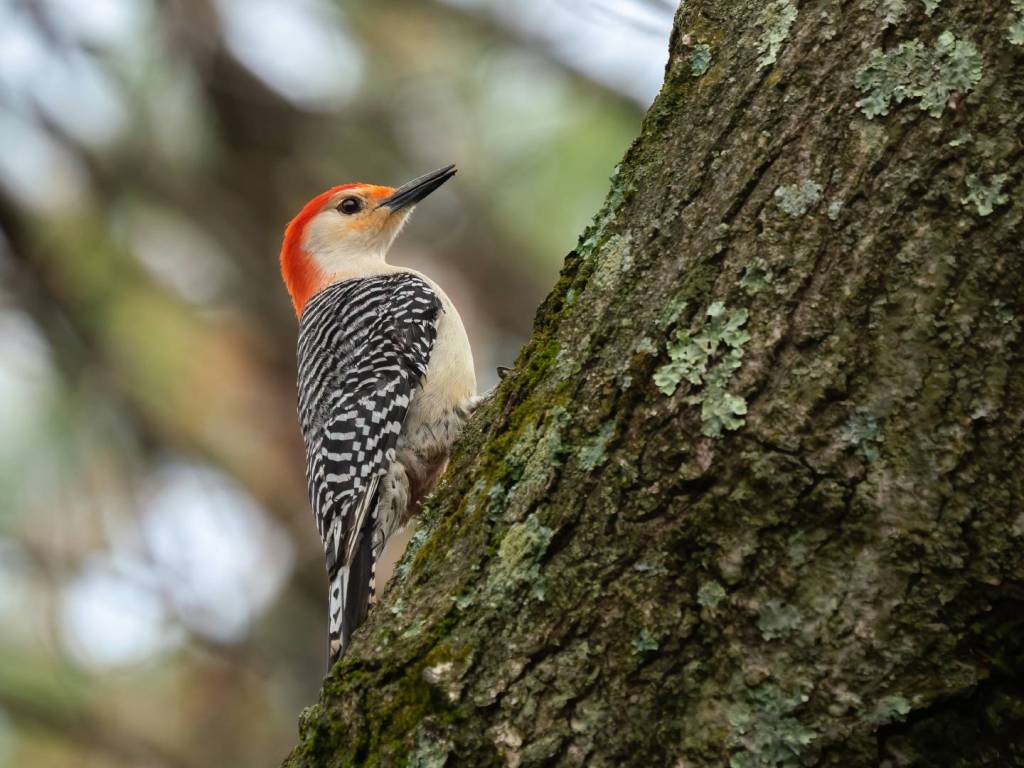
Red-bellied Woodpeckers are widespread across the eastern half of the United States. Their range stretches from Florida up to the Great Lakes and southern New England, and westward into Texas and the eastern edge of the Great Plains. You won’t find them in the far western states, but they’re a common sight in the Southeast, Midwest, and parts of the Mid-Atlantic.
They prefer deciduous forests but adapt well to mixed woodlands, river bottoms, and even suburban neighborhoods with mature trees. You don’t need a deep forest to spot one; just a tall oak, maple, or pine will do. They’re cavity nesters, which means they rely on dead or dying trees for nesting sites. A standing dead tree, or even a limb with soft wood, becomes prime real estate.
Suburban and urban areas with bird feeders, especially suet or peanut feeders, often attract them. As long as there’s tree cover and some food, these woodpeckers make themselves at home. Their adaptability to human-altered landscapes has helped them expand their range northward as humans encroach on their habitats.
You might notice them mostly during the spring and early summer when they’re more vocal and active, but they don’t migrate. They are year-round residents, sticking to their territory even through the winter. When food is scarce, they’ll come closer to backyards with feeders, which we will talk about in the next section.
Their territory can be several acres wide, especially in less dense forests, and they often return to the same nesting and foraging spots season after season.
What Do Red-bellied Woodpeckers Eat?
Red-bellied Woodpeckers have a varied diet that changes depending on the season. Insects make up a big portion of their meals during the spring and summer. They’ll dig into bark and deadwood for beetles, ants, larvae, and other invertebrates. Their barbed tongues can extend nearly two inches past the tip of the bill, making them perfect for fishing out critters buried deep inside the wood.
In the fall and winter, they turn to nuts, seeds, and fruit. Acorns, hickory nuts, and beech mast are high on the list. They also take advantage of berries from dogwood, holly, and even poison ivy. You’ll sometimes see them stashing food, jamming seeds or bits of fruit into bark crevices for later.
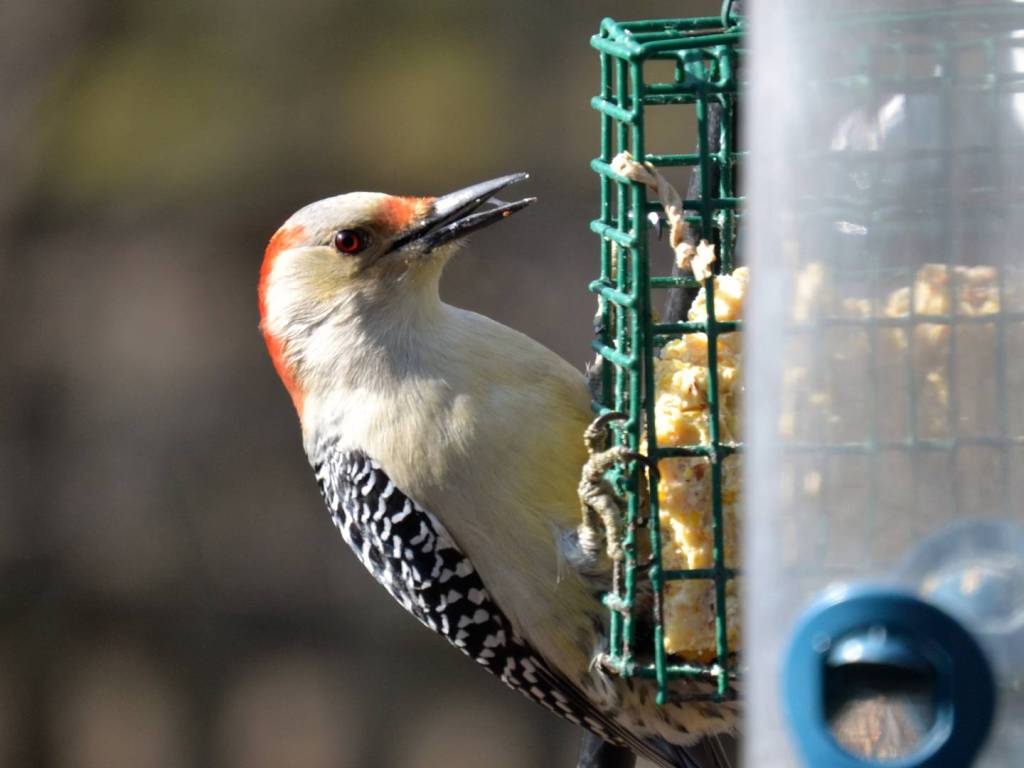
They also visit bird feeders. Offer sunflower seeds or peanuts in our hopper feeder to attract them. But if you’re trying to bring them in reliably, suet is your best bet. They’re especially drawn to suet cakes in cage-style feeders or tail-prop suet feeders, which give them space to brace with their stiff tail feathers like they would on a tree, mimicking how they would naturally feed.
Red-bellied Woodpeckers aren’t shy about eating from unusual places either. They’ll visit hummingbird feeders to sip sugar water, and they’ve even gone after sap wells made by sapsuckers. They’re opportunistic and persistent.
Their movements while feeding are methodical and purposeful. They cling to vertical surfaces, probe with quick jabs of the bill, and sometimes hop sideways around tree trunks. You’ll often hear them before you see them, especially when they hammer on wood while searching for a snack.
Interesting Facts About the Red-bellied Woodpecker
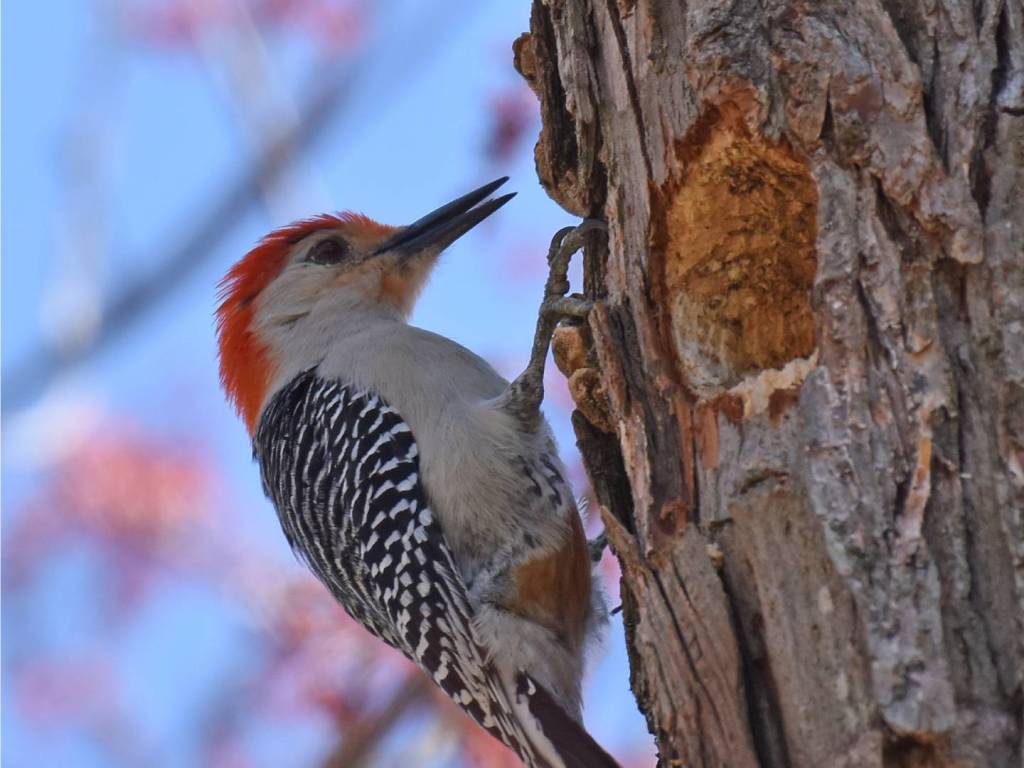
Red-bellied Woodpeckers have a few quirks that make them stand out. Like other woodpeckers, they have a specialized tongue that wraps around the back of their skulls. This lets it reach deep into cracks and crevices for insects most birds can’t access. The tongue tip is barbed and sticky, great for snagging insects.
Their brains are protected from all that pounding by a combination of factors. The skull has spongy bone near the front, their beaks absorb some of the shock, and the brain is tightly held in place. This keeps them from scrambling their own heads while hammering dozens of times a second.
They don’t just drum to find bugs; it’s also a key form of communication. Males in particular will drum to stake out territory or attract a mate. They’ll pick the loudest surfaces they can find—metal signs, gutters, or hollow branches—to amplify the sound.
Red-bellied Woodpeckers are also known to be aggressive when it comes to defending their nesting sites. They’ll chase off other birds, squirrels, and even snakes. Once a cavity is claimed, it’s theirs for the season.
Despite being strong fliers, they usually move in short, bounding flights between trees. Their undulating flight pattern, where they flap a few times then glide, makes them easy to recognize while in flight.
And while they mostly live in forests, they’re surprisingly comfortable around people. Their adaptability has made them one of the most commonly seen woodpeckers east of the Rockies.
Symbolic and Personal Meanings Associated With the Red-bellied Woodpecker
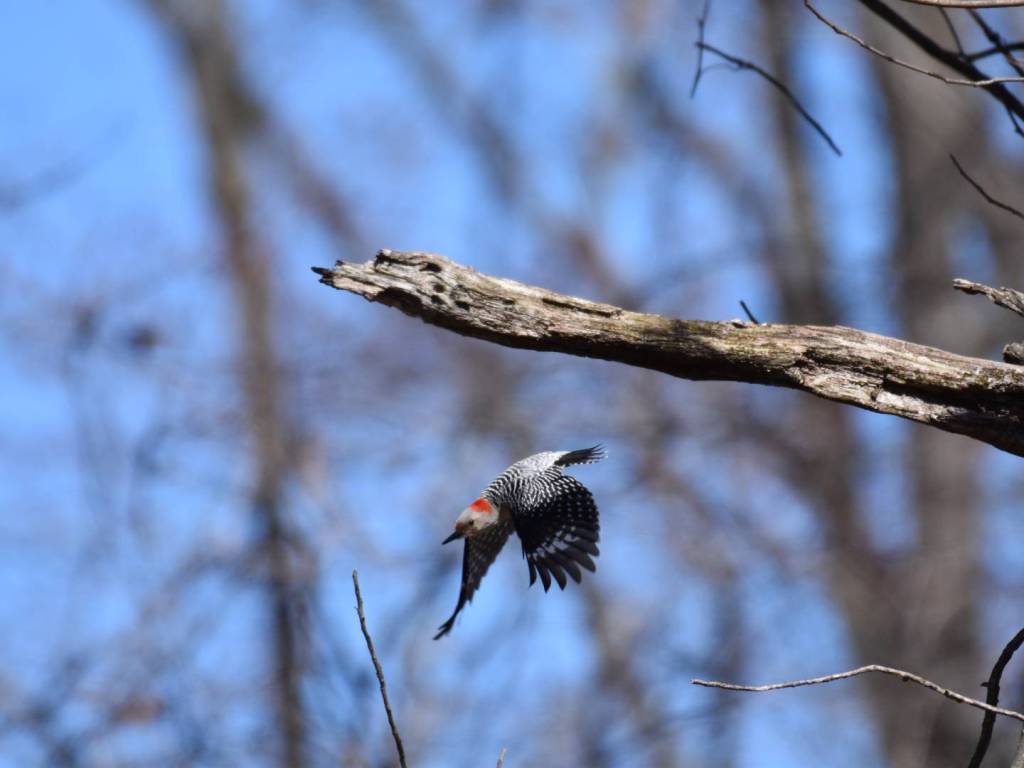
For folks who look to nature for signs or meaning, the Red-bellied Woodpecker can carry some distinct symbolism. Across various personal beliefs, this bird often represents attention, resourcefulness, and determination. Seeing one up close or hearing its call can be taken as a reminder to stay alert, to listen, to observe, and to generally be aware of what’s going on around you.
Their constant drumming and probing into trees reflect persistence. Spiritually, that can translate to digging into your own life or thoughts to uncover what’s hidden or unresolved. If this bird shows up during a time when you’re trying to decide, some interpret it as a prompt to keep going, stay focused, and to keep working at it.
Because they stash food and return to the same places, some also see them as symbols of preparation and long-term thinking. In that sense, seeing one could be a nudge to plan or store up what you need, whether that’s knowledge, energy, or actual resources.
They’re also vocal and unapologetically present in their space. That boldness has led some to associate them with speaking your truth or being more confident in their surroundings.
There’s no single universal meaning. Interpretation often depends on your own outlook and what’s happening in your life. But for people who follow signs in nature, a Red-bellied Woodpecker is rarely seen as random. It often brings a message, whether it’s about persistence, awareness, or trusting your instincts.
Conclusion

Spotting the Red-bellied Woodpecker’s flash of red on a tree trunk is a delight. With its sharp call, bold markings, and determined habits, it brings a strong presence to forests and backyards alike. Whether you’re out on a trail or just watching from your kitchen window, spotting one offers a chance to slow down and pay attention. From the way they forage to how they defend their space, these birds are a solid example of focus and adaptability. They thrive in changing environments and aren’t afraid to make some noise. If you see one nearby, take a minute to watch its movements. You’ll learn something, not just about the bird, but maybe about how to approach your own day with a little more purpose.
FOR MORE INFORMATION ABOUT THE RED-BELLIED WOODPECKER, CHECK OUT THE AUDUBON SOCIETY AND CORNELL LAB
SHARE WITH YOUR FRIENDS
FOLLOW US FOR MORE
One response to “Red-bellied Woodpecker (Melanerpes carolinus): How to Identify, Attract, and Understand This Bold Backyard Bird”
-
[…] © Wing Watchers with Wagner […]
LikeLike


 Wing Watchers with Wagner
Leave a comment